What happens when a product designer owns strategy, design, and build.
A side project I co-founded needed a landing page to sell spots in a diploma program on mental health and the menstrual cycle — to trained skeptics. No dev team, no agency, no runway: just one scroll to educate, build trust and convert.
View live site →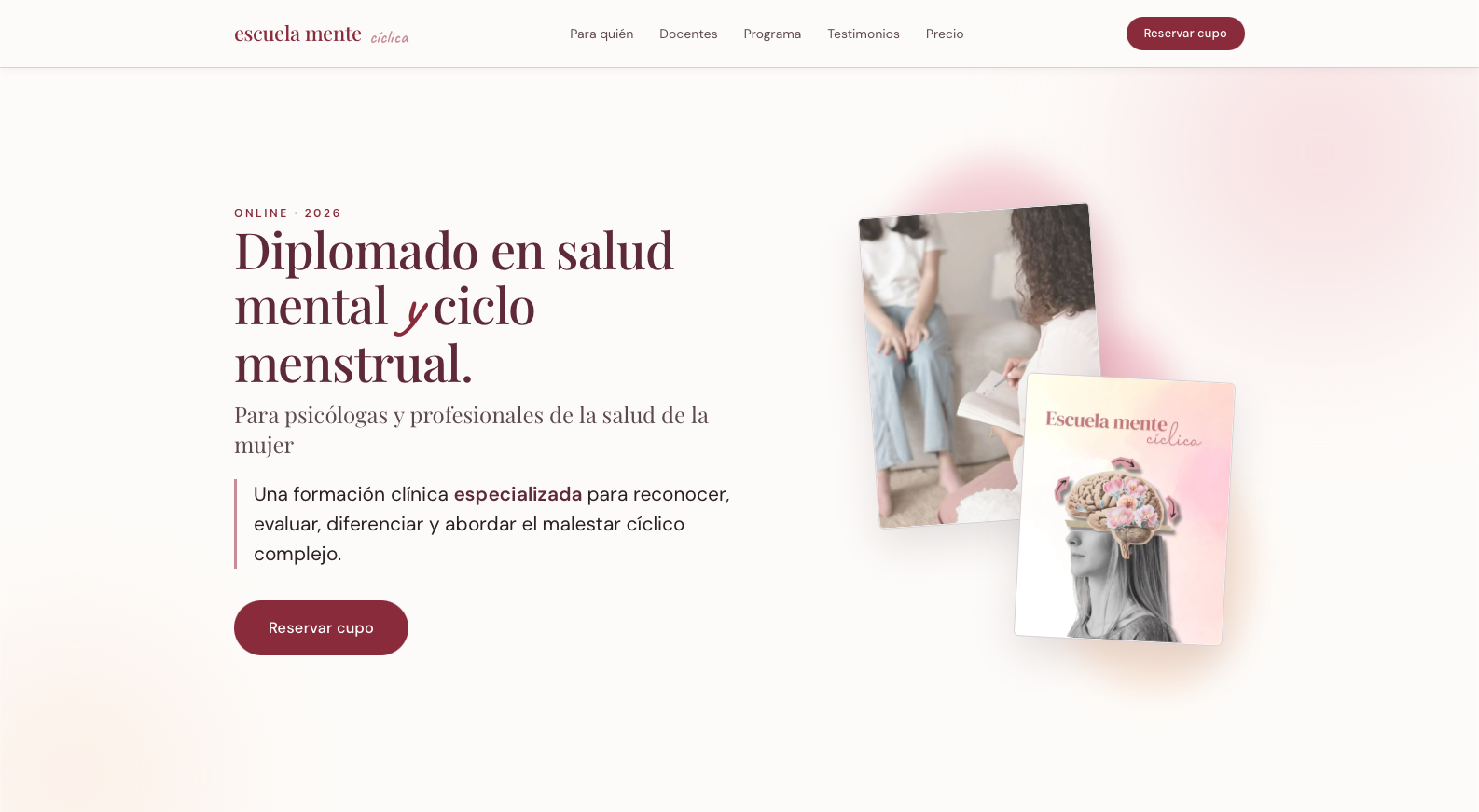
One page. No safety net.
A side project I co-founded needed one thing: a landing page to sell spots in a diploma program on mental health and the menstrual cycle — targeted at female health professionals, a trained-skeptic audience that doesn't respond to hype.
No runway. No hype allowed.
For the business: no dev team, no agency, no runway — whatever shipped had to convert, or the program had no way to sell seats. For the user: health professionals are trained skeptics. They don't respond to hype — they respond to evidence, structure, and a case that holds up to scrutiny.
Educate, build trust, convert — all in one scroll.
Strategy, design and code — one person.
Everything: I designed and developed the entire page using Claude Code as a co-builder. Copy architecture, conversion flow, trust hierarchy — every decision grounded in psychology and UX craft, static HTML/CSS/JS, deployed on Netlify via GitHub.
Evidence before the ask.
Health professionals don't respond to hype — so the page earned trust before it asked for anything. Credentials and evidence, sequenced ahead of the sale. One scroll, one decision, no detours.
One scroll, sequenced to persuade.
- 01Copy architecture — sequenced for a skeptical reader, not a hyped one
- 02Conversion flow — one scroll, one decision
- 03Trust hierarchy — credentials and evidence before the ask
- 04Stack — static HTML/CSS/JS, no framework
- 05Deploy — Netlify via GitHub
The market was the test.
No formal usability testing — with no runway for a research phase, validation was the market itself: ship it live, and watch whether trained skeptics actually convert over the first 30 days.
Ten sales, one month.
One designer, the whole stack.
What this proved: end-to-end product ownership compresses decisions and sharpens coherence. AI-assisted development expands what a product designer can ship alone — without sacrificing quality.
One designer, the whole stack, a page that sells.